From 15 January 2020 to 8 March 2020, every eligible Malaysian can redeem RM30 from the government! Excellent news! However, with 3 distribution platforms – GrabPay, Boost and Touch N Go and each offering different promotions, how do you know which one offers the best bang for your bucks? You won’t go wrong with any, given they are all widely accepted. See my analysis below:
Touch ‘n Go
Getting RM60 in total sounds like a good deal. However, the blunder of TnG not coping with the initial volume probably have sent most users to other platforms.
If you’re not eligible for the RM30 voucher, fret not, TnG has something for you! See below!
Let’s hope I’m the first ONE million
Boost
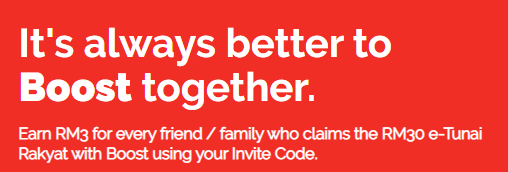
Not gonna lie, Boost is looking good with all these attractive offers & games
RM 8,888 is hella sexy. However, if there is only one reward, with 5 million Malaysians on the platform, 1/5,000,000 sounds nil. I’d assume the expected value is 0 in this case. I am guessing most distributions would be at the lower end of <RM1.
UPDATE: Similarly as TnG, Boost offers a free shake for those who applied through the platform despite being ineligible for the offer.
The Ang Pows offer up to RM10 if you’re in it for a day. To continue the challenge, you gotta send one of the Ang Pows to another friend who is not already in the challenge. The circle will quickly become saturated in that case.
Boost is doing something right by offering a promo code to also encourage people to adopt this platform
My referral code is cin29ds2 if anyone is interested 🙂
GrabPay
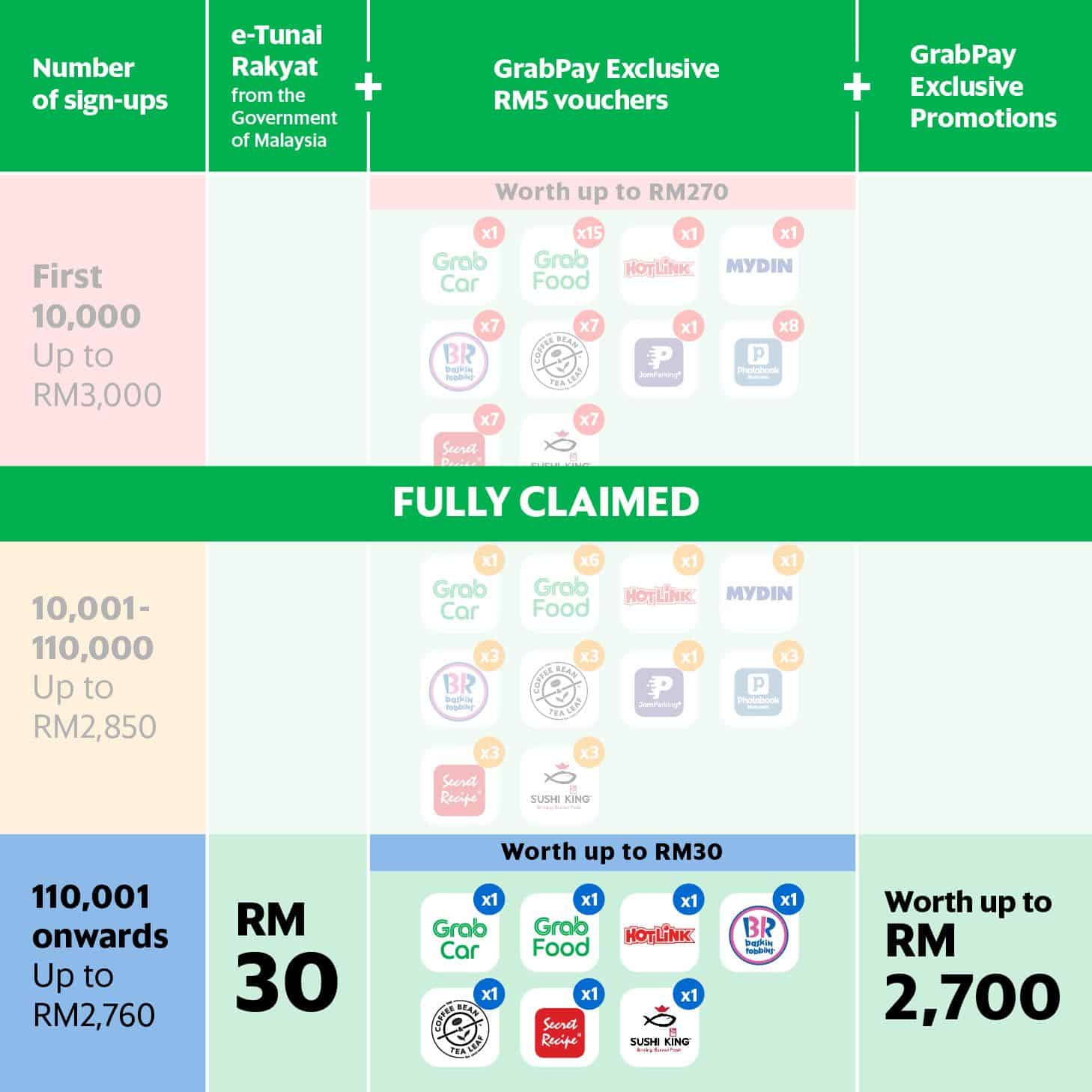
Uh Oh I’m kinda late in writing this. THE BEST DEALS ARE ALL GONE!
Grab is really good at creating the sense of urgency, but if you look at what is being offered, it is actually worse than TnG. You have to spend money at the specific vendors to actually redeem the vouchers. If you frequent the said vendors, good for you. Otherwise, I’d say TnG gives you better value.
All in all, I’d rank them in the following order in terms of reward :
Boost
TnG Wallet
GrabPay
I personally went with TnG for its simplicity. You only have to spend at one of its 120,000 vendors to qualify for the extra RM30 cash back. (Source) While Boost might give you potentially higher return, it relies on the game of chance and requires you to actually spend time doing the challenges.
Do you agree with the ranking? Let me know what you think!
In my previous post, I briefly mentioned about time value of money and opportunity cost. Today, I am going to focus on opportunity cost. From a numerical perspective, it is easy to define what cost is – essentially the price you pay in exchange for something. What about value? How do you stick a number to value? How do you define opportunity cost in that transaction? There are a few ways to think about it.
Hourly wage
This is applicable to any salaried employees, just like myself.
To calculate your hourly wage, it is as simple as taking your net income per month (including EPF contribution through employer) and dividing it by the number of hours you work, or are at work. Illustratively, If I make RM5,600 a month net and I spend 160 hour a month at work, my hourly wage is RM35/hour.
It sounds little isn’t it? Every day I spend about 1/3 of my day at work, and potentially longer if I include the hypothetical commute time of 2 hours – the proportion of time I spend at work is closer to 42%. If I include the commute time in my calculation, my hourly wage is even lower – now it is RM31/hour.
Now, instead of looking merely at a price tag and the “I can afford it” mentality, try to look at every service or product you are trying to purchase – how many hours of work in exchange for that? If you hate every working hour with a passion, this metric should help you in evaluating your decisions.
Interest foregone/accrued
This is a FIRE/personal finance favourite, easily illustrated by the following scenario, or the well known “latte effect”. Starbucks is often the victim example, but given the climate in Malaysia, I will replace it with “bubble tea effect”.
A cup of bubble tea now is approaching RM12/cup. If you get a cup of RM12 bubble tea a week (hopefully sugar free), 52 weeks x 12 = RM624/year. Let’s say if you invest the money at a 6% per annum interest (624 x 1.06^20), you’re actually forgoing RM2,000 instead of RM624 in the bubble tea drinking habit.
Another crucial example is interest accrued on debt or credit. If you have RM1,000 right now and you have a credit card debt of RM1,000 running at an interest p.a. of 18%, ALWAYS pay the credit bill first, unless investing the money returns you a guaranteed interest of 20%. Doesn’t sound realistic? That’s why paying credit card comes first.
Cost per use and resale value
The reason why we buy something is that we expect to derive value out of it, but what is the right price to pay? You can tackle it by considering the cost per use. If a game is RM60 and you obtain an enjoyable experience of 60 hour, the cost for such entertainment is only RM1. While the ‘value’ that one can derive from such activity varies from person to person (and the opportunity cost for spending time on such events), you can use such method to evaluate the purchase.
Another thing to take into consideration is resale value. Just go on any second hand market place such as Carousell, mudah, lelong etc. to know what prices some of the second hand items fetch. For instance, Myvi has a better resale value than Axia of the same mileage and the depreciation is not as drastic. From anecdotal personal experience, stuff like clothes and books have almost nil resell value. Think extra hard about the utility of such purchase. I mostly end up just donating my books to the library and I swear by ebooks now.
IRR/NPV
In corporate finance, evaluating business opportunities using the Internal Rate of Return (“IRR”) and Net Present Value (“NPV”) is a common practice. NPV is a more preferred method for a number of reasons which I will leave out. If you’re interested, the great web has a plethora of sources that will explain the intricacies to you.
Using the NPV method is beneficial as it incorporates the following elements: timing of cash flows, be it negative or positive, and time value of money or cost of capital. If the NPV is positive, the project is worth pursuing; and if not, you get the gist. While your prediction may not be 100% accurate, it gives you a good way to think about pursuing certain projects and how you should allocate resources.
I will give an example, and you can find the worksheet for this exercise here.
NPV worksheet – to pursue a master’s degree or not (Link)
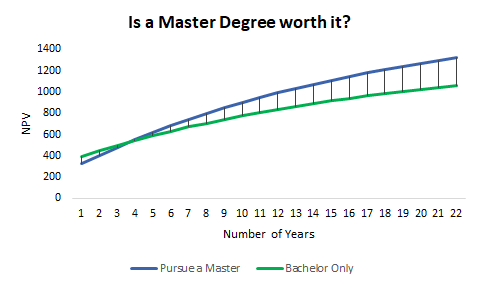
Let’s say I want to pursue a master degree in data science in an American university. Room and board, and course fees are about USD80k a year. I am forgoing a year’s worth of salary, USD80k to pursue this degree but I expect that I can get an incremental USD40k per year for 5 years. Should I pursue this option?
Graph from Excel file
Based on the model, it takes about 4 years for that to happen. Whether it is worth it or not, it depends on you. The model is simplistic, but you can play around with the assumptions.
There are other capital budgeting methods such as breakeven period, but NPV trumps them all.
That’s all from me this week. I’m trying to keep up a posting frequency of once per week so do stay tuned!




 moneymonies.business.blog